Rethinking 100 Years of “KARAWANE”

– Ein vergleichbarer Text in deutscher Sprache wurde in diesem Blog im Februar 2016 zum 100-sten Jahrestag der Gründung des Cabaret Voltairs in Zürich veröffentlicht

– In an other text in this blog, which is about the first opening of the Cabaret Voltaire 100 years ago please find diagrams of the photographs.

Compared to the reproduction of a lost painting of Marcel Janko, which shows the interior of the Cabaret Voltaire in Zurich, some contradictions appear in the photograph of Hugo Ball receiting his poem „KARAWANE“ June 23rd 1916. So there is the question: What happened in the bar of immigrants around 1916 and what did artists when not performing there to make a living in these hard times and to reflect the situation?

Hugo Ball receiting KARAWANE, 1916 (Quelle: H. Ball 1886 - 1986, Leben und Werk, Pirmasens 1986, S. 134

Hugo Ball receiting KARAWANE, 1916 (Quelle: H. Ball 1886 – 1986, Leben und Werk, Pirmasens 1986, S. 134

Examining the picture of Ball in his costume we see the artist-philosopher standing on a carpet in front of an undefined wall. It looks provisory and seems to be from cardboard or plywood. The curtain could deliver an argument for the stage but one of the manuscripts on the music-stands is overlapping it. This set does not look very much like a stage in a cabaret. They might have had curtains but why they cover the wall and not the stage?

Curtains in front of walls however are common however in a photographer’s studios. And there is an other photograph showing Ball in front of a camera around the same year 1916. The picture shows the same carpet; however a person appears in a different costume, which hides the face under a roll of paper with a huge “13” replacing the artist’s eyes, ears, nose and mouth. That makes him silent, without sight, dump and unable to scent. Topped with a top hat it represents a bourgeois, not being able to open his senses for the situation full of innovations and chances.

Hugo Ball receiting KARAWANE, 1916 (Quelle: Raoul Schrott, Dada 15/25, Köln 2004, S. 54)

Hugo Ball and the poem 3 PIFFALAMOZZA, 1916 (Quelle: Raoul Schrott, Dada 15/25, Köln 2004, S. 54)

The way of innovations

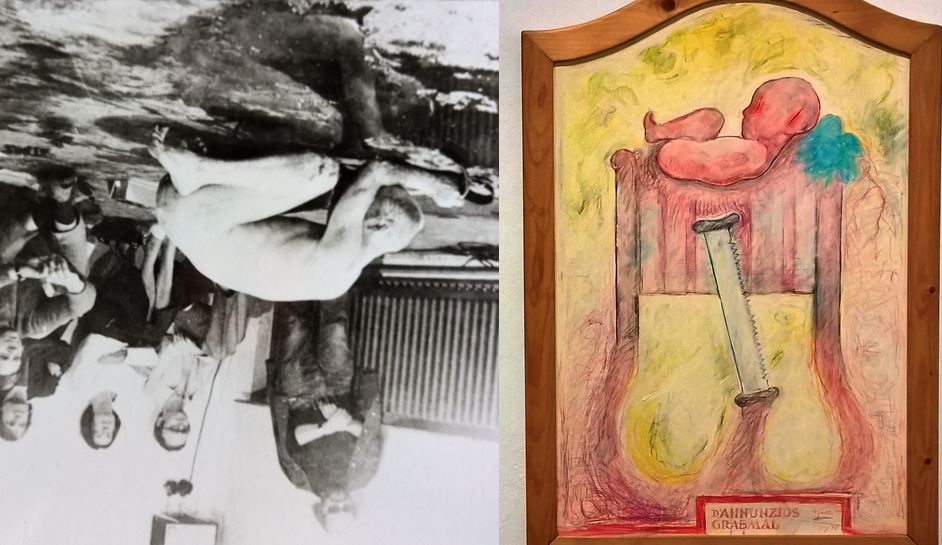
The print of a lost painting of Marcel Janco of 1916 illuminates the space and the atmosphere of the cafe-house of immigrants with Dadaists performing simultaneously on a stage in front of a small space filled with an audience. Being aware of such a stuffed place filled with a smoking audience one may ask, where a photographer with a tripod would find a stand with a clear view during a life act on a small stage?

Marcel Janco, lost painting of 1916 (Vorlage: Arche Literatur Kalender 16.-22. Feb. 2015)

Marcel Janco, lost painting of 1916 (Vorlage: Arche Literatur Kalender 16.-22. Feb. 2015)

The observations on documents about the happenings at the Cabaret Voltaire and their quotations over the decades may lead an observer to reflect about the character of innovations. It is remarkable that artists and researchers have been attracted by the few documents about DADA, especially the rare ones about the short Dadaistic career of Hugo Ball, without getting to the crucial point in it. Finding the Dadaistic spirit in chaos and anarchy they missed the nicely planned and directed part in the work of Hugo Ball who was smart enough to consult a professional photographer and rehearse the visual part his performance in a studio. As the former dramaturge of the Münchner Kammerspiele he and the unknown photographer were able to produce the relicts of his ephemeral artworks for the future and to create an image, which looks as if it was taken during the performance. Taking that in account it becomes obvious that it is the un-authenticity of the image, which is responsible for the iconic character it has for DADA until today.

Also the typography of the poem is famous, although it is not fully understood either. We do not know how it sounded in 1916, but nevertheless we call it a sound-poem, as the changing characters give the idea of changing voices. Both of the documents of “Karawane” are “simulacra” in the sense of the “hyperreal” (Jean Baudrillard) that transform the surface of everything undergoing the forces of human activity, which is making everything “real” but destroying its metaphysics.

To give an idea of that, which is destroyed, Ball described the performance very precisely in his diary and called the reading of the poem different from the visual appeal of the poem in various types, monotonous like a litany. By giving it the appeal of a collective ritual in catholic churches Ball recalls the metaphysics missing today. It was not only stress that motivated him to leave the dada-circus shortly after that and beginning his study in the history of Christianity. He was a taboo-breaker and doing so he became aware of his time, which makes him after Nietzsche a protagonist in reflecting the trap of modernity.

Referring to Balls writings on “Byzantine Christianity” in the 1920s it becomes evident, that the “Bishop” of “Karawane” was one of the “saints” and “heroes” Ball was searching for, when he looked for ways to tame the “furor teutonicus”, which he was part of. At the outbreak of World War I Ball himself tried to become a volunteer in August 1914 however he was invalided out for health reason. It becomes obvious, that he worked on the attraction of war, which got so many artists and intellectuals, who – surprising to us –  were excited by war and numerously volunteered. Being aware of this we can see that Balls turn to his two iconic figures is a way to seek distance from that involvement and find out way he became intrigued into this. In unpublished notes for a foreword to his polemic “Kritik der deutschen Intelligenz” (Bern 1919) Ball states, that the gesture of “the rebel disappeared”. Instead he was seeking for ways to integrate the desire of the savage, which was another big issue of DADA.

@ Johannes Lothar Schröder

Mit Politikern schmusen

Während des Wahlkampfs vor den Wahlen zur Hamburgischen Bürgerschaft 2008 forderte der Hamburger Künstler Christian 3Rooosen Freunde und Kollegen auf, mit „Politikern zu schmusen“. Das bedeutete für alle, die mitmachten, mit Plakaten, die eigentlich für eine Fernbetrachtung gestaltet werden, auf Tuchfühlung zu gehen, eventuell das Plakat zu umarmen und die Oberfläche zu streicheln, mit dem Gesicht zu berühren oder zu küssen. Damit durchbrachen die Akteure die Distanz zu den Gegenständen, die den öffentlichen Raum zeitweise möblieren. So erlangten sie symbolisch eine Nähe zu prominenten Politikern, die selbst bei öffentlichen Auftritten durch Sicherheitsvorkehrungen und Personenschutzleute vom Publikum abgeschottet werden.

Foto: 3Rooosen

Foto: 3Rooosen

Die Intervention drehte diese Distanz in ihr Gegenteil, indem Umarmungen, Streicheleinheiten und Küsse eine intime Begegnung mit den Bildträgern herbeiführten, wobei die dabei entstandenen Videos und Fotos der Aktion das Trennende, das auf den Plakaten durch die von der Wirklichkeit abweichenden Größenverhältnisse gegeben ist, zusätzlich abschwächten. Deshalb scheinen die real schwer unüberbrückbaren Schranken mittels der Dokumente der Aktionen auf einer visuellen Ebene ebenso nachhaltig durchbrochen worden zu sein wie zuvor durch die Aktion.

Populisten suchen Nähe

Street-Art und Graffiti-Künstler arbeiten ähnlich, doch zielen sie auf ein sichtbares visuelles Ergebnis ihrer Intervention ab, wogegen 3Rooosen gerade erreichen will, dass die von ihm inszenierten Performances als Interventionen im öffentlichen Raum live gesehen werden. Insofern ist es durchaus folgerichtig, dass er als Aktionskünstler die Videos erst jetzt – also 8 Jahre nach der Aktion – auf YouTube gestellt hat.

https://www.youtube.com/watch?v=6kdwmNKE3yM

3Rooosen empfiehlt dazu folgende Musik zu laden:

https://www.youtube.com/watch?v=2bsdkj_JkYs

Was also aus Sicht der Live-Art nicht so bedeutend sein mag, trifft dagegen in den sozialen Medien in Zeiten des wachsenden Populismus auf einen aktuellen Kontext. Populisten reagieren ja auch auf eine gefühlte Entfernung von gewählten Volksvertretern. Sie unterstellen ihnen pauschal Ahnungslosigkeit sowie Abhängigkeit von einflussreichen Geldgebern und Beratern und reagieren mit der in den sozialen Medien praktizierten Distanzlosigkeit, die sich bei realen Begegnungen im öffentlichen Raum gar nicht so respektlos entfalten könnte. Da Politiker physisch nicht leicht erreichbar sind, erzeugt die dadurch gegebene Distanz einen emotionalen Überschuss, der bei manchen Menschen schon in Wut und Hass umgeschlagen ist, wie die Angriffe auf Oskar Lafontaine, Wolfgang Schäuble und Henriette Reker bezeugen.

Schmusen mit Politikern, courtesy 3Rooosen

Schmusen mit Politikern, courtesy 3Rooosen

Populisten nutzen die mangelnde Nähe zwischen Profipolitikern und Wählern und geben sich kumpelhaft sowie durch markige Sprüche scheinbar volksnah. Dank des permanenten und massenhaften Austauschs von einfachen Erfolgsrezepten in den sozialen Medien sind viele dieser Volkstribunen überzeugt, dass sie den Schlüssel für die Lösung komplizierter Probleme hätten. Sie bemerken dabei nicht, dass ihre Ideen selbst auf die Distanz zurückzuführen ist, in der sie sich zu aktiven Politikern sehen, von denen sie naiverweise annehmen, diese hätten das anscheinend Offensichtliche noch nicht bemerkt.

Nähe als Illusion

Dieses Spiel mit Erreichbarkeit zwischen Publikum und Politikern setzte 3Rooosen durch seine Aktion auf eine bemerkenswerte Weise in Szene. Er ließ die Plakate für seine Protagonisten zu lebendigen Symbolträgern werden und überwand die Distanz zu den Abgebildeten durch eine offen vorgetragene Illusionslosigkeit. Jeder weiß, dass die Bilder nicht mit den Abgebildeten identisch sind, doch gelangen die Personen auf der medialen Ebene der Abbildung zueinander. Anders als in der Life-Aktion sind die Protagonisten des Künstlers auf dem Video ebenfalls zweidimensionale Abbilder und erlangen so dieselbe mediale Präsenz wie die Politiker.

Da 3Rooosen als Künstler auf seinem Feld, also der Herstellung von Illusionen arbeitet, erzeugte er den direkten Umgang mit dem Medium im Sinne von McLuhan, der das Medium als die Botschaft definierte. Dabei geht es nicht um den Glauben an die Beeinflussung des Publikums, sondern die unmittelbare eigene Aktion als konkrete Beeinflussung von Zuschauern und Mitwirkenden, wodurch 3Roosen eine überraschende Nähe zu den scheinbar so entrückten Politikern erreichte, die gerade heute wieder ins Bewusstsein rückt, obwohl viele Zeitgenossen vor lauter Wischen auf der glatten Smart-Phone-Oberfläche vergessen haben: Politiker sind zwar austauschbar aber konkret handelnd. Die zeitversetzte Veröffentlichung der 8 Jahre alten Videos zeigt fast schon vergessene Politiker auf den Plakaten und verdeutlicht, wie schnelllebig politische Kampagnen sind. Dagegen ist es frappierend zu erleben, dass die Plakate von Politikern tatsächlich eine Nähe herstellen können. Deshalb kann die Auseinandersetzung mit der symbolischen Ebene gerade der populistischen Suche nach Nähe und Direktheit, die auch einer falsch verstandenen Performance-Art unterstellt wird, entgegenwirken.

Der Umgang mit Performance-Art, die oftmals mit dem Authentischen spielt, aber selten ihre Wirkung daraus bezieht, kann heute helfen, den Irrglauben zu erschüttern, mit dem in den Medien und unter Veranstaltern kokettiert wird, um Performances als Besonderheit aller möglichen Aufführungstypen anzupreisen. Ein jüngstes Beispiel ist die in diesem Monat gesendete dreiteilige Produktion von ZDF und 3SAT über Performances, in der wider besseres Wissen z.B. die Legende von der Heilung des verletzten Jagdfliegers Beuys durch Krimtataren als Tatsache kolportiert wird. Dagegen ist es geradezu lehrstückhaft, wie 3Rooosen in seiner neueren Performance „Bilder singen“ vor leeren Leinwänden den Inhalt eines Bildes singt, um die Illusion eines Inhalts durch eine Performance aufzurufen (über den obigen YouTube-link einfach zu erreichen). Hierdurch wird das Bild unmissverständlich als ein suggerierbares individuelles Resultat der Vorstellungskraft beschworen.

Liberated Letters on Wheels of Poetry

A year ago Schröder was invited by “City of Wandsbek” to roll mono-wheels made from manuscripts in the streets of Hamburg-Wandsbek and through a near shopping mall. He asked passengers to through dices and contribute a number of letters equally to the numbers on the dice. Over the days from May 8th to 30th Schröder collected around 8000 letters, which were written by markers in different colors and thickness on the surfaces of the wheels. By rolling them the rotating objects generated sequences of words, names and tags depending on how members of the audience would look at the object.

Johannes Lothar Schröder: Rad der Poesie, Photograph: A. Galeano, johnicon, VG-Bild-Kunst

Johannes Lothar Schröder: Rad der Poesie,
Photograph: A. Galeano, johnicon, VG-Bild-Kunst

For more pictures and infos refer to: wandsbek1.de/foto-galerie
Also the pdf of the catalogue is available as dowonload: http://www.wandsbek1.de/dokumentation/

Johannes Lothar Schröder: Rad der Poesie Photo: Andrés Galeano, johnicon, VG-Bild-Kunst

Johannes Lothar Schröder: Rad der Poesie
Photo: Andrés Galeano, johnicon, VG-Bild-Kunst

Historically wheels of poetry were the latest objects in a series, in which Schröder recycles parts of his archive.  He started around 2000 to glue piles of manuscripts to carpets, which he for the first time showed as stage design of “Botenbösermär” (messengersofbadnews) in 2003. This theatrical piece, in which Necla Akgün combined the reports of ancient messengers, who had bad news in Greek tragedies of Aishylos, Sophocles and Euripides like “The Persians”, “Medea”, “Antigone” etc.

Later Schröder showed new and bigger versions of these objects to manifest that performance-art does not have traditional spaces like the opera, the cinema, the music-hall, the theatre, the painting-collection etc.  Elements built out of the paper-carpets were used as models of ambulant architecture like hangars, which could be used to store relicts of performances or even host performances.

Johannes Lothar Schröder: Rad der Poesie. Photograph: A. Galeano, johnicon, VG-Bild-Kunst

Johannes Lothar Schröder: Rad der Poesie. Photograph: A. Galeano, johnicon, VG-Bild-Kunst

Liberated Letters

Installations of that kind were realized during performance-festivals at Szczecin and Salzau www.performance-festival.de und during conferences of Performance Studies international (PSi) in New York, Mainz, Copenhagen und Utrecht. However the roots of his dealing with letters dig deeper in his personal art-history, in which he got early inspirations by the French Afficists in the 1960s and the Lettrist or Parole in libertà of the Futurists.

In relation to the liberated words of the Futurists Schröder calls the writings on his paper-objects „Liberated Letters“, which can be also read of recited in front of audiences.

follow Twitter: @radderpoesie

wandsbek1.de

all photographs ©johnicon, VG Bild-Kunst, Andrés Galeano