Über TIMESWINGS von Rasmus Gerlach
Einen Dokumentarfilm über Hanne Darboven zu drehen war für Rasmus Gerlach nicht ganz einfach, denn im Jahr ihres 75sten Geburtstags war die Künstlerin schon 7 Jahre tot. Gedreht wurde in ihrem Studio und in den Ausstellungen, mit denen man die Künstlerin 2015/16 im Haus der Kunst in München und in der Bundeskunsthalle in Bonn würdigte. Darüber hinaus konnte Gerlach an eigene Begegnungen anknüpfen, denn er durfte als Schüler bei der Einrichtung einer Ausstellung von Darboven im Kunstraum Bremerhaven mitwirken. Das war eine lebensentscheidende Erfahrung, die ihn später dazu bewog, Film zu studieren.
„Vier Jahreszeiten – Der Mond ist aufgegangen“ (1981/82)
Opus 7 und 16mm-Film von Hanne Darboven
An der Kunsthochschule in Hamburg traf Gerlach Darboven wieder, als er ihren damals neuen Film „Vier Jahreszeiten – Der Mond ist aufgegangen“ (1981/82) abspielte, der nun am 5.1.2017 im Doublefeature mit TIMESWINGS im Hamburger Metropolis-Kino abermals aufgeführt wurde. Der damalige Filmriss ist bis heute sichtbar geblieben, weil er mit einem Stück Schwarzfilm geflickt worden war. Der 16mm-Film von Darboven fügt Aufnahmen aus Hamburg-Harburg von trostlosen Nachkriegsbauten für Industriearbeiter mit Impressionen von der lokalen Kirmes zum Schützenfest, Landschaftaufnahmen vom jüdischen Friedhof und Innenaufnahmen aus dem Bauernhaus der Darbovens zusammen. Aus den dort gesammelten Objekten ragen überlebensgroßen Figuren – Pferd, Saurier, Engel und Roboter hervor. Sie sind umgeben von klassischen Büsten, Kinderspielzeug, Andenken aller Art, einen Bismarck in Bronze und Nippes. Überall in Regalen und Schränken, auf Möbeln und Sitzgelegenheiten liegen Bücher, Ordner, Sammelwerke mit zigtausenden Seiten, die die Künstlerin handschriftlich und mit Schreibmaschinen füllte. Der mit dem gleichnamigen Opus 7 der Künstlerin vertonte Film zeigt den Mikrokosmos, den die Künstlerin um sich herum anwachsen ließ, bis er sie und ihre tägliche Arbeit wie ein Korsett umschloss, während die Harburger nur einmal im Jahr das Vergnügen haben, aus ihren trostlosen Häusern herauszutreten, um die Kirmes, diesen wohlfeilen Kosmos der Armen, zu besuchen.
Zeitbuchhaltung im Bauernhaus
Dieses Mal hatte Gerlachs Film „TIMESWING“ das Publikum in Hamburg auf den Film der Künstlerin eingestimmt, der den 2015 noch weitgehend unveränderten Zustand der Sammlung zeigt, aus dem Speditionsangestellte bereits Stücke für die beiden Ausstellungen entnahmen und verpackten, wodurch sich die Idee eines Schaulagers vermittelte. Hier stellte sich auch der Tierarzt zum Gespräch ein. Weggefährten und Verwandte wurden anlässlich der Feier zum 75. Geburtstag der Künstlerin interviewt. Ehemalige „Co-Workers“ der Künstlerin wussten über die mit ihrer Hilfe verwirklichten Projekte zu berichten. Historisches Filmmaterial aus einer Fernsehdokumentation aus den 1980er Jahren rundete die aktuelle Dokumentation ab und machte die Einbettung des Hofgebäudes in den landwirtschaftlichen Betrieb auf dem Familiengut anschaulich. Zwei landwirtschaftliche Helfer gabelten Strohballen zum Füttern aus der Scheune, und die Künstlerin lockte ihre zwei Ziegen vor die Kamera. Aussagekräftig waren Aufnahmen anlässlich einer der legendären Weihnachtsfeiern, die das Gesicht der gewöhnlich ernsten Kunstarbeiterin löste und zur Musik einer Zigeunerkapelle erstrahlen ließ. Ein Signal der festtäglichen Lust, die den streng geregelten Alltag unterbrach, der der Aufzeichnung des Zeitlaufs, dem Sammeln und Organisieren von Bildern, Zeitungen und Zeitschriften und dem Ausfüllen von Kalenderblättern, mit eigenen graphischen Strukturen versehen Papieren gewidmet war.
Die Sammlung von Objekten kombiniert mit den eigenen Aufzeichnungen der Künstlerin z.B. mit dem Projekt „Schreibzeit“ belegt den Versuch, Kontrolle über die Lebenszeit zu erringen. Später werden die Kalender abstrakter, indem die Zeit zu Formeln verdichtet wird, die aus Quersummen von Jahreszahlen gewonnen werden, wodurch schließlich ein Schritt hin zu den Noten einer eigenen Notenschrift begangen wird, der die Schreibarbeit in Klänge überführt. Ihr musikalisches Werk wurde schon einmal in der Musikhalle (heute: Laeiszhalle) in Hamburg aufgeführt jedoch von der Kunst- und Musikwelt ignoriert. Heute bilden die Kompositionen neben den Sammlungsstücken zu denen auch eine Sammlung von Musikinstrumenten gehört den Kern der Räume in den Museumsaustellungen. Inmitten der wandfüllenden Papierarbeiten und zwischen den dort installierten Objekten aufgeführt entsteht der Eindruck eines mit Zeit gesättigten Gesamtkunstwerks.
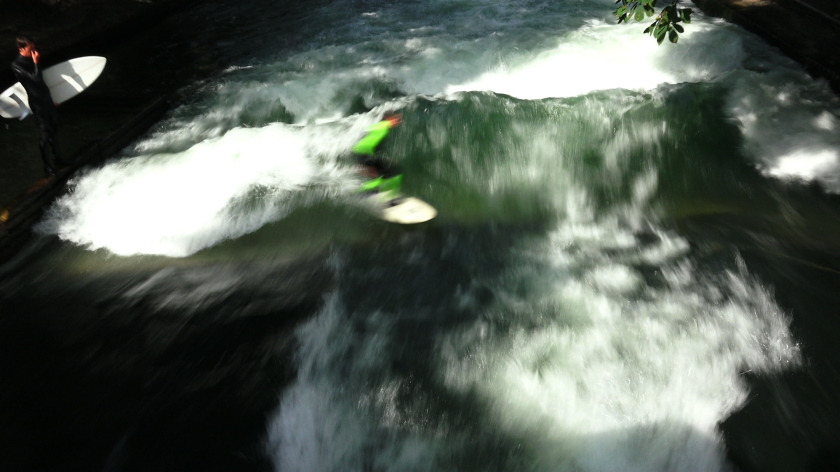
Stehende Welle, Filmstill aus „TIMESWINGS“, 2016, courtesy Rasmus Gerlach
Statische versus ephemere Kunst
Die Verunsicherung des Leiters des Hauses der Kunst, der sich dabei beobachtet fühlte, wie er eine Position zu den Darbovenschen Objekten finden musste, die eine Kaufmannsfamilie aufgehäuft hat, die nicht nur als Kaffeeröster vom Kolonialismus profitiert hat, und die Einbeziehung der Geschichte des Haus der Kunst führten zum Rauswurf des Dokumentarfilmers, der sich daraufhin in der Nähe des Ausstellungshauses umschaute. Dort stieß er auf ein besonderes Sinnbild der Zeit, die „Stehende Welle“ der Isar, auf der das ganze Jahr über gesurft wird. Der Fluss rauscht hier ununterbrochen mit hoher Geschwindigkeit in den Englischen Garten und doch wirkt die Welle statisch, so dass die tollkühnen Surfer sich je nach Geschick zeitweilig auf ihr halten können, bis sie von der Strömung fortgerissen werden. In dieser Begegnung von Menschen und Naturschauspiel hat Gerlach eine plausible Metapher für das Werk Darbovens gefunden, die übrigens 1941 in München geboren wurde.
Dieses Sinnbild führt unmittelbar zur Frage der Zeit auch in der Performancekunst, die in diesem Blog untersucht wird. Nichts scheint der Performancekunst ferner zu liegen als das Werk von Hanne Darboven, die auf der Suche danach, die Zeit zu fixieren, ein Werk unglaublichen Ausmaßes materialisiert hat, das die hohen Wände mehrerer größer Ausstellungshäuser gleichzeitig komplett zu bedecken vermag. Wir haben es also mit einem Vermächtnis zu tun, das einer Einzelnen gedankt ist, die sich unerschütterlich in den Fluss der Zeit stellte, um ihn Augenblick für Augenblick, Tag für Tag mit grafischen Mitteln, der Schrift, der Fotografie, dem Films, der Komposition und der Mathematik zu protokollieren. Es ist der Versuch, in dieser konstanten Bewegung des Vergehens der Zeit Halt zu suchen.
In diesem Bemühen ist Hanne Darboven als Konzeptkünstlerin in einer Richtung, die von Männern dominiert wird, einzigartig aber nicht allein. Ihr Werk weist Parallelen zu „Jahrestage“ (1971ff) von Uwe Johnson, das ebenfalls von einem Aufenthalt in New York inspiriert worden war, und den Arbeiten der Hamburger Künstlerin Anna Oppermann auf. Obwohl sie sich schon früh gegen andere, namentlich literarische Versuche der Fixierung von Zeit mit dem Einwand abgegrenzt hat, dass es sich um abgenutzte Mitteilungsformen handeln würde[1], ist es wichtig, den Kontext der 1970er und 1980er Jahre zur Kenntnis zu nehmen, in dem Fotografie, Schreib- und Kopiermaschinen Möglichkeiten versprachen, die Fixierung von Zeit in den Griff zu bekommen.
Das Ringen um die Zeit, das von Darboven mit buchhalterischen Mitteln ausgetragen wurde, bleibt allerdings weiterhin fraglich, denn mit Tino Sehgal gibt es Gegenpositionen in der Performancekunst, die ganz ohne Material auskommen, weil sie den Spuren vertrauen, die Leben, Bewegungen, Äußerungen und Begegnungen im Menschen ohne eine dokumentarische Beglaubigung hinterlassen.
(c) Johannes Lothar Schröder
[1] Uwe M. Schneede über H.D. in: Kasper König (Hrsg.), von hier aus: 2 Monate neue deutsche Kunst in Düsseldorf, Köln 1984, S. 40.